Stand in the Market Square on a Tuesday evening in October — not August, not a festival weekend, Tuesday — and you have the beginning of a Wrocław city guide that actually means something. The Town Hall is fourteenth-century Gothic, lavishly ornamented, the kind of building that communicates across seven hundred years that the people who built it intended to be here for a very long time.
They were not. Or rather: they were, and then they weren’t, and then entirely different people arrived and rebuilt it — almost stone by stone, using the original plans — because the building had been nearly destroyed in 1945 and the city that inherited it decided the inheritance was worth honouring.
This is where Wrocław begins. It is also where it becomes complicated in the best possible way. The city was German — Breslau — for most of its modern existence. It was Silesian before that, which is something else again. After the war, by the redrawn geography of Potsdam, it became Polish. Its German population was expelled. The Poles who came to fill the empty apartments were themselves, largely, displaced — arriving from Lwów, now Lviv in Ukraine, a city they had also loved and also lost.
The full account of this history belongs to Norman Davies and Roger Moorhouse, Microcosm: Portrait of a Central European City (2002) — worth finding at your nearest independent bookshop before or after you go.
So the people who rebuilt Wrocław were not rebuilding their city. Because they were rebuilding someone else’s city, in a language they did not fully speak, in a tradition that was not quite theirs, while carrying the grief of the city they had been made to leave. And what they built, over seventy years, is genuinely beautiful, genuinely itself, and unlike anywhere else in Europe.
This is the kind of city The European Itinerary exists to document: chosen not for what it looks like but for what it teaches.
The Thing That Opens onto History
The architecture of the rebuilt Old Town tells you, if you look carefully, that it was reconstructed rather than preserved. The buildings are slightly too consistent, the colours slightly too confident, the proportions slightly too clean. This is what a city looks like when it is reassembled from photographs and memory rather than simply maintained. It is not inferior — in some ways it is more intentional than the organic layering of a city that simply survived. However, it is different. The buildings are real. The city they constitute is, in a deep sense, an act of collective imagination.
What to Eat in Wrocław — and Why It Reveals Something
Silesian food sits in an interesting gap between Polish and German culinary traditions. It has been largely overlooked because Silesia itself has been politically awkward for most of the past century. Go to Kurna Chata on the edge of the Old Town, or any restaurant describing itself as kuchnia śląska, and order the żurek — a sour rye soup served in a hollowed bread bowl, with hard-boiled egg and white sausage. It looks modest. It reveals depth. The sourness is not an aggressive tang — it is the slowness of fermentation, the patience of a culture that takes bread seriously. Moreover, if you are paying attention, it tells you something specific about what happened when two culinary traditions were forced to occupy the same kitchen and produce something neither had made before.
The Thing Most Visitors Miss
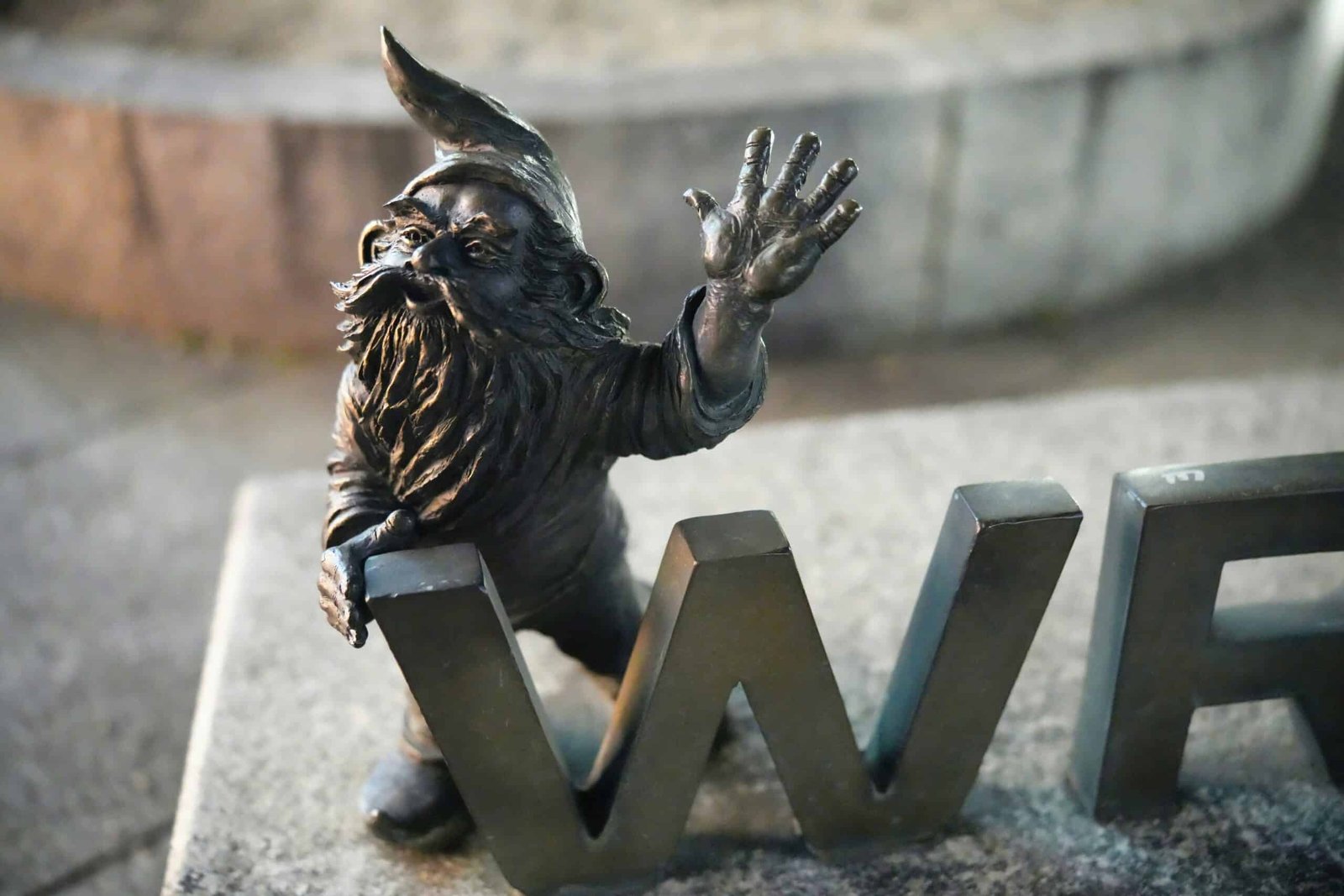
They photograph the gnomes. Wrocław has several hundred small bronze dwarf figures scattered across the city — on bridge railings, at street corners, climbing drainpipes — and tourists find them charming. They are also, if you know what you are looking at, the physical residue of one of the most inventive anti-communist protest movements in Polish history. The Orange Alternative began here in the 1980s. Activists painted small orange dwarfs on walls that censors had whitewashed over illegal political graffiti. The police could not arrest people for painting dwarfs. The absurdity was the point — a form of political resistance that the regime could not process because it refused to take the regime’s categories seriously.
Before you photograph the first gnome, read the Culture.pl account of the Orange Alternative — Poland’s official cultural institute has the definitive English-language account of the movement.
The Argument Wrocław Makes About European Identity
What Wrocław demonstrates — more clearly than almost any other city in Europe — is that identity is not fixed. It is made, rebuilt, chosen, accumulated. A city can absorb total rupture: the loss of its population, its language, its architecture, its name. Furthermore, if the people who arrive in its ruins treat the inheritance as an obligation rather than an imposition, something genuine eventually grows. It takes time. It takes something close to will. The result is not the same as what was there before. It is not a simple continuation of what the newcomers carried with them. It is a third thing, and it is theirs.
This is, in fact, a fairly precise description of what the European Union is attempting on a continental scale: take people with very different histories, deposit them in a shared space, and see whether something coherent and genuinely mutual can be built from the overlap. Wrocław has a seventy-year head start on the answer.
What Wrocław Teaches About European Cities
Warsaw was destroyed and rebuilt as itself — an act of national will. Kraków was spared and remains, magnificently, what it always was. Any Western European capital of consequence has the luxury of continuity. Wrocław alone shows you what it looks like when people arrive somewhere that does not belong to them, decide to belong to it anyway, and get it — slowly, imperfectly, movingly — largely right.
Ostrów Tumski — Cathedral Island — after dark. The only part of Wrocław still lit by gas lamps, tended by a lamplighter. It is the oldest part of the city, predating all the ruptures, and it is the quietest argument available for the long view.